
Temp-to-Hire
Call Center Staffing:
A Smarter Model
For years, that model worked well enough.
Permanent-first hiring has long been viewed as the responsible and stable approach to building a call center or inside sales team. When a CRO, VP of Sales, or talent acquisition leader makes a direct permanent hire, they are signaling confidence in their selection process and in the long-term contribution of that individual. The organization invests in onboarding, ramp time, compensation, and cultural integration with the assumption that the decision has already been validated.
For years, that model worked well enough.
But the modern call center and inside sales environment operates under very different conditions. Service levels are more visible. Pipeline contribution is measurable in real time. Revenue per seat is trackable. At the same time, hiring has become more complex. Candidate presentation has improved due to recruiting technology and AI-assisted resume optimization. Interview processes are more standardized, yet no more predictive. Applicant pools are larger, but clarity has not necessarily improved.
As a result, “well enough” hiring outcomes no longer satisfy high-performing organizations that depend on consistency, predictability, and measurable contribution.
In response, a growing number of revenue-driven organizations are restructuring their hiring strategy. Rather than committing to permanent placement from day one, they are adopting a temp-to-hire staffing model for frontline customer service and inside sales roles, particularly SDRs, BDRs, account executives, and other non-traveling revenue seats.
This shift is not rooted in hesitation. It reflects a recalibration of risk.
In performance-driven environments where each seat influences pipeline, conversion, service levels, and customer retention, hiring accuracy has become a strategic priority. Leaders are recognizing that long-term commitment should follow demonstrated performance, not precede it.

The Limits of Prediction-Driven Hiring
Most traditional hiring strategies are built on prediction.
Interviews attempt to forecast behavior. Resumes attempt to forecast competence. References attempt to forecast reliability. The assumption underlying permanent-first hiring is that, with enough structured evaluation, future performance can be anticipated with reasonable accuracy.
Decades of research suggest otherwise.
In one of the most cited meta-analyses in industrial-organizational psychology, Schmidt and Hunter (1998), published in Psychological Bulletin, found that general mental ability tests and work-sample tests significantly outperform interviews in predicting job performance. Structured interviews showed moderate predictive validity, but unstructured interviews performed far worse.
Harvard Business Review has echoed this concern in multiple articles examining hiring bias and interview overconfidence, including “The Problem with Using Interviews to Evaluate Candidates.”
In practical terms, interviews measure presentation. They do not fully measure behavioral sustainability under pressure.
Call centers and inside sales teams sit squarely in that category.
An SDR may present confidence in a controlled interview setting and still struggle to handle rejection volume week after week. A customer service representative may articulate strong empathy but falter when average handle time targets must be maintained without sacrificing quality scores. These are not failures of character. They are mismatches between projected ability and lived performance.
In revenue roles, performance is not theoretical. It is measured daily through activity metrics, conversion rates, adherence, QA scores, and pipeline contribution. Underperformance becomes visible quickly, but only after commitment has already been made under a permanent-first model.
High-performing teams are increasingly questioning whether prediction alone justifies full upfront commitment.
Temp-to-hire changes that sequence.
Instead of asking whether a candidate appears likely to succeed, leaders observe whether they do succeed under real operating conditions before extending permanent placement.
The Financial Impact of Getting It Wrong
Hiring mistakes are expensive in any industry. In revenue and call center environments, they are amplified.
The Society for Human Resource Management estimates that replacing an employee can cost between one-half and two times that employee’s annual salary when recruitment, onboarding, lost productivity, and training costs are factored in.
In contact centers specifically, attrition rates have historically outpaced many other industries. ContactBabel’s annual U.S. Contact Center Decision-Makers’ Guide consistently reports annual attrition rates that can reach 30 to 45 percent depending on role and geography.
For revenue leaders, this is not just a staffing issue. It is a growth constraint.
When an SDR leaves early, pipeline velocity slows. When a BDR underperforms, meeting volume drops. When a customer service representative exits during ramp, service levels shift and senior reps absorb overflow, increasing burnout risk.
Permanent-first hiring assumes that the risk of misalignment is acceptable at the point of commitment.
Temp-to-hire introduces a financial buffer. By structuring an initial evaluation period before full financial obligation is earned, organizations reduce the probability of long-term investment in short-term fit.
For CROs and VPs responsible for both headcount growth and quota attainment, that risk-sharing matters.
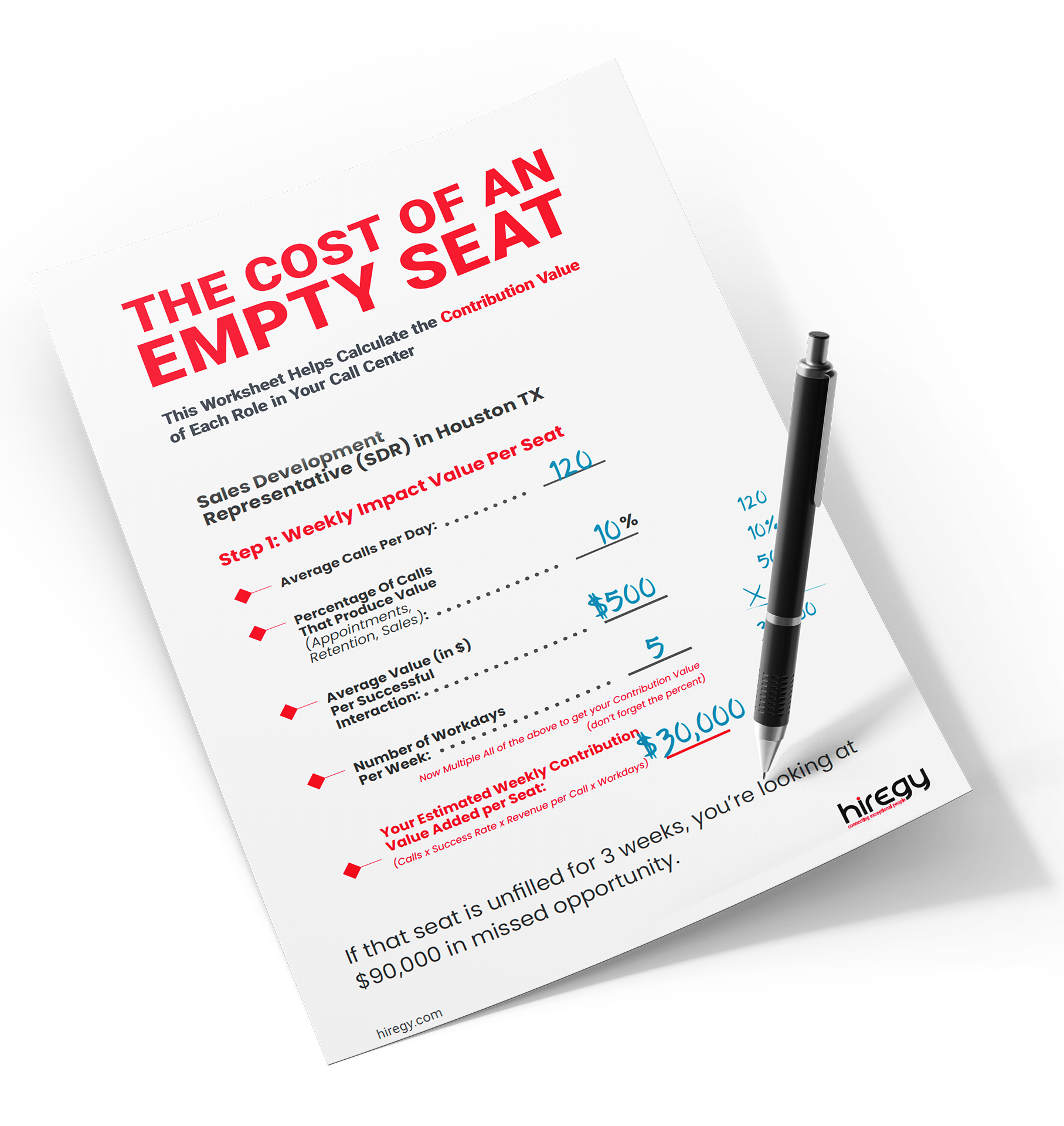
What Does an Empty Seat Really Cost During Tax Season?
High call volume + open roles = longer hold times, stressed teams, and lost opportunities.
Use our Cost of an Empty Seat Worksheet to quickly calculate the real impact of understaffing, in dollars and performance.
Cultural Sustainability Is Behavioral, Not Theoretical
Culture fit in call centers and inside sales teams is not abstract. It is operational.
These environments are structured, metrics-driven, and performance-visible. Coaching is frequent. Expectations are clear. Output is tracked. Some professionals thrive in this structure. Others struggle under sustained visibility and volume.
Research on realistic job previews published in the Journal of Applied Psychology demonstrates that when candidates experience actual job conditions before full commitment, early turnover declines and role alignment improves.
Temp-to-hire effectively functions as an extended work-sample period. It allows both the employer and the candidate to validate behavioral alignment under real conditions.
Instead of relying solely on interview answers about adaptability and resilience, leaders can observe actual performance trends, response to coaching, attendance consistency, and week-over-week improvement.
In revenue teams, that observational window provides clarity that no interview framework can replicate.
What Temp-to-Hire Looks Like in Practice
For CROs, VPs of Sales, and talent acquisition leaders, the appeal of temp-to-hire is practical, not philosophical.
Inside sales roles surface leading indicators quickly. Activity levels, call quality, booked meetings, pipeline contribution, and coachability appear within weeks. Performance does not need months to reveal trajectory.
What differentiates Hiregy’s approach is how financial alignment is structured.
Unlike traditional recruiting firms that collect their full placement fee when a candidate starts, Hiregy’s inside sales placement model is milestone-based.
One-third of the placement fee is collected when the candidate begins employment.
A second third is earned at day forty-five.
The final third is earned at day ninety.
If the candidate does not reach those milestones for any reason, the remaining portions of the fee are waived.
This structure makes Hiregy fiscally vested in the success of every placement. Financial commitment aligns with demonstrated performance. The recruiter’s incentive does not end at day one.
For revenue leaders managing SDR, BDR, and account executive growth, this reduces volatility in hiring spend and creates shared accountability.
Before a search begins, Hiregy conducts a structured intake process designed to clarify expectations around compensation structure, performance benchmarks, reporting lines, coaching cadence, and cultural dynamics. That blueprint increases alignment before candidates are presented. The milestone-based fee model reinforces alignment after start.
Temp-to-hire in this context is not temporary staffing. It is performance sequencing.
Rethinking Commitment in a Revenue-Driven Environment
The shift toward temp-to-hire call center staffing is not a reaction to uncertainty. It is a response to measurable economics.
Interviews remain useful but limited predictive tools. Research shows that work-sample observation outperforms conversational assessment. Turnover carries documented financial cost. Attrition in contact centers remains structurally elevated. Revenue seats are performance transparent.
Taken together, these factors create a clear conclusion.
Permanent-first hiring places full commitment at the point of projection.
Temp-to-hire places commitment after observation.
That structural difference changes the risk profile of workforce decisions.
As 2026 workforce strategies take shape, revenue leaders face pressure to grow headcount without increasing volatility. The organizations that outperform will not simply hire faster. They will hire more accurately.
Temp-to-hire protects operational stability while preserving the ability to scale.
Permanent-first hiring assumes alignment.
Temp-to-hire confirms it.
If You Are Scaling Revenue in 2026
If you are expanding your SDR, BDR, or inside sales team and want a recruiting partner whose incentives extend beyond day one, it may be worth exploring whether this model aligns with your goals.
Shaun explains the milestone-based structure in the accompanying video, including how Hiregy only earns its full fee when the candidate performs and remains in seat through defined benchmarks.
If you are curious how this approach could reduce hiring volatility while protecting growth targets, schedule a conversation. The process begins with a structured intake designed to understand your revenue blueprint, performance expectations, and hiring criteria before a single candidate is introduced.
Hiring accuracy improves when commitment follows performance.
And partnerships work best when incentives are aligned
More Insights from the Call Center Staffing Experts
From hiring tips to leadership strategies, our blog is your go-to resource for call center success. Dive into more articles from the staffing experts at Hiregy

Strategies to Attract Top Administrative Talent in Florida
Most businesses in Florida realize how important it is to have great administrative help. Admin teams are business-support stars who help everything run smoothly.

Job Growth in Jacksonville Florida
Jacksonville, the city where the St. Johns River meets the Atlantic Ocean, is making waves in the job sector. With the city’s population and business sectors both experiencing significant growth, it’s no wonder that job growth Jacksonville, Florida is a hot topic of discussion in economic and business circles.

Attracting and Retaining Employees
Given today’s competitive job market, your organization needs to be on top of its game to attract and retain the brightest minds. And as employee expectations evolve, it’s also important to reevaluate your hiring and retentions strategies continually to stay ahead.