
Before the Phones Light Up:
How to Prepare Your
Call Center for
Spring & Summer Demand
Seasonal Demand In Call Centers Is Rarely Accidental.
Whether driven by tax cycles, enrollment periods, product launches, healthcare utilization shifts, or consumer buying patterns, spring and summer consistently create measurable increases in contact volume across industries.
Yet many organizations still approach these predictable surges as if they are unexpected disruptions rather than operational certainties.
The difference between a stressful peak season and a profitable one is rarely volume itself. It is preparation.
Seasonal Demand Is Predictable (Even If It Feels Sudden)
Call centers supporting customer service, sales, healthcare operations, or financial institutions often experience cyclical volume increases beginning in late Q1 and accelerating into Q2.
For retail and e-commerce environments, spring promotions and summer campaigns drive higher inbound inquiries and post-purchase support. Healthcare support teams see shifts tied to coverage changes, billing cycles, and patient scheduling activity.
Financial institutions and credit unions manage everything from tax-related activity to seasonal spending increases.

While the triggers vary by industry, the pattern remains consistent: volume rises within defined windows.
The operational risk emerges when staffing models are built around average volume rather than peak demand. Planning for averages almost guarantees service-level pressure when predictable surges arrive.
When queues lengthen and handle times increase, the impact extends beyond metrics. Supervisors are pulled into live queues. Coaching time shrinks. Quality assurance becomes reactive. Experienced agents absorb emotional labor at higher rates. Over time, burnout risk increases.
Volume alone does not destabilize performance. Misaligned staffing does.
The Hidden Cost of Waiting Too Long to Hire
One of the most common miscalculations in seasonal planning is underestimating ramp-to-productivity timelines.
Hiring is not instantaneous capacity. Even in high-volume environments with efficient recruiting processes, the path from sourcing to full productivity includes screening, interviewing, background checks, onboarding, training, and nesting periods. Depending on complexity, that process can take four to six weeks, sometimes longer in regulated industries such as healthcare or financial services.
If volume is projected to increase in May, hiring conversations should begin in March, not April.
Reactive hiring compresses timelines, reduces candidate quality, and increases training strain. Proactive hiring protects both service levels and internal leadership bandwidth.
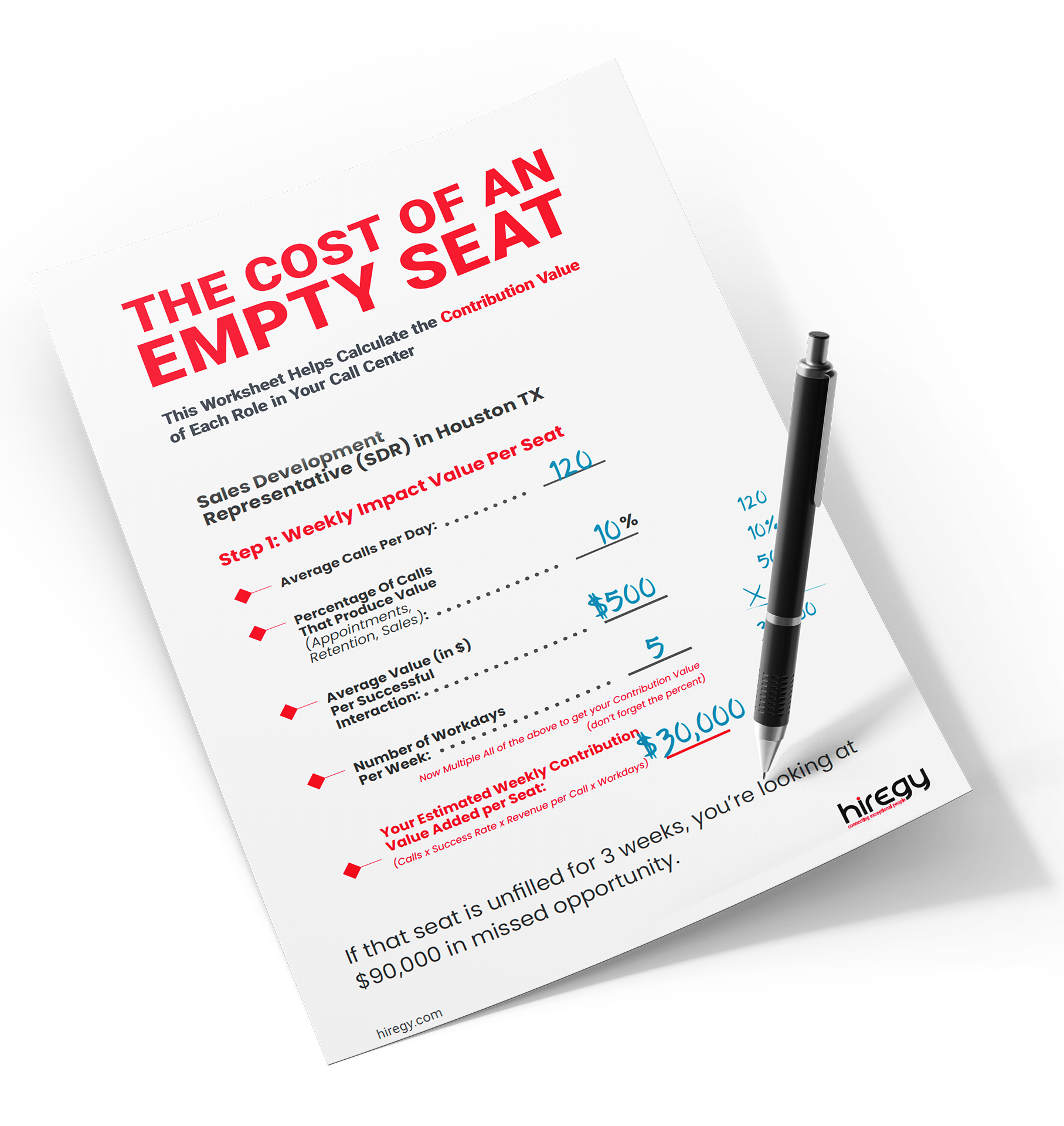
What Does an Empty Seat Really Cost During Tax Season?
High call volume + open roles = longer hold times, stressed teams, and lost opportunities.
Use our Cost of an Empty Seat Worksheet to quickly calculate the real impact of understaffing, in dollars and performance.
What Strong Workforce Planning Actually Looks Like
When seasonal pressure builds, organizations often lean on overtime to absorb excess demand. In the short term, this can stabilize queues. Over extended periods, however, sustained overtime contributes to fatigue, reduced engagement, and higher attrition following peak season.
Research examining high-volume contact environments consistently links elevated cognitive load and emotional labor to increased stress when staffing levels do not align with workload. When agents lack sufficient recovery time, performance metrics begin to decline, not because skill has diminished, but because capacity has been exceeded.
The cost of replacing experienced agents after a burnout-driven resignation often exceeds the cost of hiring strategically ahead of peak demand.
Seasonal volume should not be managed through exhaustion.
Spring & Summer Surges Expose Structural Gaps
Peak periods act as stress tests. They reveal whether training programs are scalable, whether supervisor ratios are sustainable, and whether workforce management forecasting is aligned with reality.
Call centers supporting healthcare organizations must maintain compliance accuracy under increased interaction volume. Sales environments must protect conversion rates while managing inbound demand. Customer service teams must preserve satisfaction scores during longer queues. Credit union and financial institution contact centers must balance empathy with regulatory precision.
In each case, seasonal strain magnifies structural weaknesses.
High-performing organizations treat the slower months as preparation windows. They analyze historical volume trends, examine handle-time shifts during prior peaks, evaluate attrition patterns, and adjust staffing forecasts accordingly. Rather than waiting for KPIs to deteriorate, they reinforce capacity before strain appears.

Flexible Staffing Outperforms Last-Minute Hiring
Adding headcount during peak season is not inherently problematic. Adding unprepared headcount is.
Seasonal staffing works best when supplemental agents already understand the operating environment. In regulated or specialized industries, context matters. Agents supporting healthcare reimbursement inquiries, member care in credit unions, or complex sales pipelines require more than basic call-handling ability. They need familiarity with terminology, compliance boundaries, and escalation procedures.
Flexible staffing models that integrate experienced professionals reduce ramp time, protect quality, and allow internal teams to focus on higher-impact interactions.
The objective is not simply to shorten queues. It is to maintain performance consistency while demand increases.
Planning for Peak Season Is a Revenue Decision
Seasonal demand often represents opportunity as much as pressure. Increased contact volume can drive higher sales conversions, improved cross-sell performance, and stronger member or customer engagement, if service levels remain intact.
When staffing falls short, the organization absorbs hidden costs: abandoned calls, reduced first-call resolution, delayed revenue capture, and reputational impact.
Preparing for spring and summer demand is not only an operational exercise. It is a financial one.
Forecasted volume increases should be evaluated alongside projected revenue contribution per interaction. Understanding the true cost of an empty seat during peak season reframes staffing as a strategic investment rather than an expense line.
The Leaders Who Win Plan Before the Phones Ring
Call centers that navigate seasonal demand successfully share three characteristics:
They forecast using historical data rather than intuition.
They begin staffing conversations well ahead of projected spikes.
They protect their core teams from overload by reinforcing capacity deliberately.
Seasonal demand is predictable. The strain it creates does not have to be.
Organizations supporting customer service, sales, healthcare operations, and financial institutions have the advantage of visibility. They can see the surge coming. The decision is whether to treat it as a recurring emergency or a planned phase of growth.
At Hiregy, we work with call center leaders across industries to design staffing strategies aligned with seasonal demand cycles. Whether supporting healthcare support teams, sales-driven environments, customer service centers, or credit union member care operations, our approach focuses on readiness, stability, and long-term performance.
If your team is approaching spring or summer demand without a clear staffing plan, now is the time to build one.
Before the phones light up.
More Insights from the Call Center Staffing Experts
From hiring tips to leadership strategies, our blog is your go-to resource for call center success. Dive into more articles from the staffing experts at Hiregy

How Credit Unions Handle Tax-Season Call Spikes Without Burning Out Teams
How Credit UnionsHandle Tax-SeasonCall Spikes WithoutBurning Out Their TeamsCredit Union Staffing During Tax SeasonTax season is one of the few...

AI Won’t Replace Recruiters, But Recruiters Who Use AI Will Win
Beyond the Algorithm:Recruiting SuccessComes From People, Not AICall Centers Still Need Human RecruitersCall center and sales leaders are asking the...

Top Grading Talent: Why the Best Leaders Rebuild Before They Hire
Top Grading Talent:Why the Best LeadersRebuild Before They HireThe New Year ResetAs 2026 approaches, call center and sales leaders are planning for...